


Athanasius of Alexandria, bishop and theologian, who was one of the primary defenders of trinitarian theology, wrote in the fourth century CE,
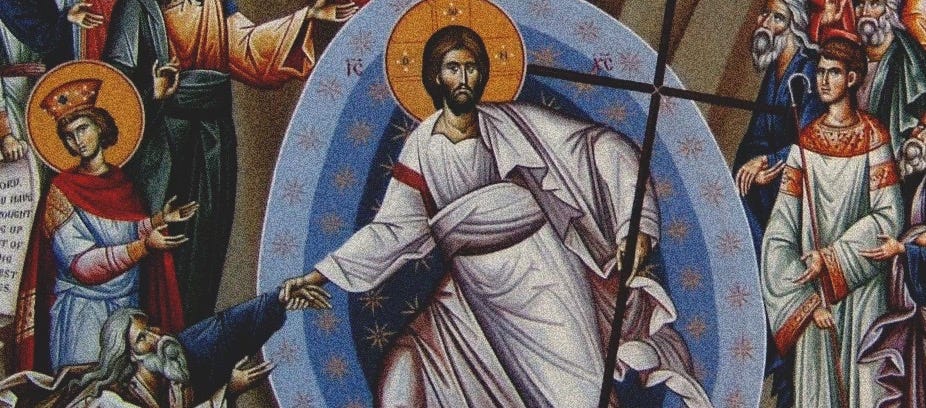
For one who sees a snake trampled down, especially if he knows its former ferocity, no longer doubts that it is dead and completely weakened, unless he is perverted in mind and does not have even his bodily senses sound. For who, seeing a lion being played with by children, does not know that it is either dead or has lost all its power? Just as it is possible for the eye to see that these things are true, so when death is played with and despised by those believing in Christ, let no one any longer doubt, nor be unbelieving, that death has been destroyed by Christ and its corruption dissolved and brought to an end.1
“The gospel,” for early Christians, meant a complete renewal of all things. Though they lived, as we do, in the tension between what was started by Christ at the Resurrection and what will be finished by Christ in the Second Coming, the totality of the Son’s work in the Incarnation was undeniable. This finished work is foundational to the Christian faith. Salvation has come from the Son, through the Son, in the Son, to the human race, which the Son became (John 1:14).
Coupled with the finished work of the Son is the recognition that we, as human beings, could not, and cannot save ourselves. The Old Testament law was not given to provide humans the means to redeem ourselves; the law was given so that humans could see the inability of our best efforts to redeem our own brokenness, in full color. As Paul writes in Romans 7:7, “If it had not been for the law, I would not have known sin.” This suggests two things:
Humans could not save themselves, but could and did lose sight of God, and in losing sight of God, lost sight of life (John 1:4 says, “In Him was life”). In losing sight of life, they were left with death, which is the absence of life. Humans needed a revelation (or revealing) of God to restore our sight and life. As 1 John 1:2 says, “This life (referring to Jesus) was revealed, and we have seen it and testify to it, and declare to you the eternal life that was with the Father and was revealed to us…”
If the lamb was slain “from the foundations (beginnings) of the world” (Revelation 13:8), and we were chosen “in him (Jesus)” from the foundations (beginnings) of the world (Ephesians 1:4), the Incarnation was not God’s response to human sin, but was God’s plan from the beginning, knowing all along the problem of human sin would be dealt with through the Son, which is why this gospel is a complete renewal of Creation, not the reward for a fraction who do the right thing(s). We couldn’t do “the right thing,” so Christ did it for us.
As an aside, the “finished work” of Jesus suggests that a previous work was started. This finished work is far greater than we’ve ever imagined. Jesus wasn’t just finishing the work of his three-year ministry; he was finishing the work of Creation, turning it back to Eden and beginning the process of restoring it to what God, first and finally, called all things in Creation: good.
Anselm of Canterbury wrote,
The human race, clearly his most precious piece of workmanship, had been completely ruined; it was not fitting that what God had planned for mankind should be utterly nullified, and the plan in question could not be brought into effect unless the human race were set free by its Creator in person.2
The vision of the gospel in the early Church, seen in the teachings of Irenaeus of Lyons, Athanasius of Alexandria, and Gregory of Nyssa to name a few, emphasized justification through the finished work of the Son in light of humanity's collective sin. The cross was understood as God’s complete victory over sin, death, and evil. It spoke of Christ becoming the second and final “Adam” (Romans 5; 1 Corinthians 15:47) to redeem the work of the first Adam once and for all. It spoke of liberation from our bondage to death and the healing of corrupted human nature, thus the Creation.
The secondary beliefs that founded the gospel of the early Church were:
God responds to sin with love.
The Incarnation was God’s original and only plan.
Jesus became humanity to eternally reconcile us to God, as in the beginning. He came to us.
The difference between the condition of human beings in the old and new covenants is the Incarnation. We, on this side of the Resurrection, exist in the Incarnate Son who is eternally divine and flesh as one.
Salvation means Christ has begun and will finish the work of restoring us and the Creation to exactly what they were created to be, from the beginning.3
Why the original gospel is better news.
The good news is better news than most of us have learned, most of our lives. Therefore, the work of modern discipleship is less about what Jesus is doing and more about who Jesus is. If we can recover the vision of who Jesus is, we will clearly see what he is doing and where he is going.
In Paul’s letter to the Galatians, Paul is combating teachers who have come into the churches of Galatia to redefine their mission and identity. These teachers are unidentified Jewish leaders urging Paul’s converts to be circumcised into the Jewish faith. Apparently, they are intrigued because Paul’s letter reads as if many of them have at least considered circumcision.
What the people of Galatia were wrestling with, and what we often find ourselves wrestling with in our own faith, is getting to God through good works (the law) versus the work of Jesus. I believe we wrestle with this because we’ve never fully understood the good news as the finished work of God's promise.
In chapter 4 of Galatians, Paul uses an Old Testament allegory to explain the difference between being enslaved to a life of effort-driven performance and being free in the effects of the promise. He writes,
21 Tell me, you who desire to be subject to the law, will you not listen to the law? 22 For it is written that Abraham had two sons, one by a slave woman and the other by a free woman. 23 One, the child of the slave, was born according to the flesh; the other, the child of the free woman, was born through the promise. 24 Now this is an allegory: these women are two covenants. One woman, in fact, is Hagar, from Mount Sinai, bearing children for slavery. 25 Now Hagar is Mount Sinai in Arabia and corresponds to the present Jerusalem, for she is in slavery with her children. 26 But the other woman corresponds to the Jerusalem above; she is free, and she is our mother. 27 For it is written,
“Rejoice, you childless one, you who bear no children,
burst into song and shout, you who endure no birth pangs;
for the children of the desolate woman are more numerous
than the children of the one who is married.”28 Now you, my friends, are children of the promise, like Isaac. 29 But just as at that time the child who was born according to the flesh persecuted the child who was born according to the Spirit, so it is now also. 30 But what does the scripture say? “Drive out the slave and her child; for the child of the slave will not share the inheritance with the child of the free woman.” 31 So then, friends, we are children, not of the slave but of the free woman.
Verse 1 of chapter 5 finishes his thought, reading, “For freedom Christ has set us free. Stand firm, therefore, and do not submit again to a yoke of slavery.”
Much of our current experience with the gospel has come through Hagar. It has enslaved us in a life defined by doing. It has made salvation about us, “asking Jesus to come into our hearts,” as if “our hearts” can contain God. The very notion that we are the ones who ask Jesus into our hearts underscores our desire to control the gospel by our own doing. Though we are incapable of salvation, as we’ve established and is well agreed upon, we insist on authority.
But salvation is about God bringing us into his heart. It’s about God, while we were still sinners, dying for us (Romans 5:8). We are children of Sarah, the free woman. We are children of the promise. We are a product, not of what we’ve done—good or bad, but of the promise of God. What is the promise of God? Genesis 1:31, “God saw all that he had made, and it was very good.”
Karl Barth wrote,
To put it in the simplest way, what unites God and us men is that He does not will to be God without us…that He does not allow His history to be His and ours ours, but causes them to take place as a common history. That is the special truth which the Christian message has to proclaim at its very heart.4
Our decision to follow Jesus is critical, not because it saves us—we are incapable of “saving us”—but because Jesus has saved us. We have the privilege of following Jesus as disciples, not because it earns us life, but because we’ve inherited eternal life through and in him. We can call on God the Father as “Abba” not because we’ve done all the right things, but because Jesus reconciled us into adoption as sons and daughters of God.
A quick opinion on why the concept of true discipleship is impoverished in the contemporary Church:
We have emphasized individual salvation where we should have emphasized discipleship. Therefore, discipleship has no place—its place has been usurped. That is how it is possible to convert masses to the faith by way of a special, repeated prayer, but see little to no fruit of discipleship in those “converted.” We teach people to sign up to go to heaven; Jesus taught people to sign up to take up their cross and follow him.
1 John 4:18 puts it best, saying, “There is no fear in love. But perfect love drives out fear, because fear has to do with punishment.”
The gospel is the better news. It’s time we start believing it.
Athanasius and C.S. Lewis, On the Incarnation, Popular Patristics Series no. 44b (St Vladimir’s Seminary Press, 2011), p. 80.
Anselm of Canterbury, The Major Works, Oxford World’s Classics (Oxford University Press, 2008), p. 269.
σώζω (sōzō) is typically, and rightly, translated as 'saved,' but it has many meanings in Greek. The best summary of what σώζω suggests is to make something whole. Salvation is not where you go when you die, but a restoration of life and vitality (now and forever).
Karl Barth, Geoffrey William Bromiley, and Thomas Forsyth Torrance, The Doctrine of Reconciliation: Church Dogmatics, Continuum Impacts (Continuum, 2004), p. 8.