


I love reading sermons from faithful preachers with a little…let’s call it “experience” behind them. One of my favorites is Frederick Buechner. Recently, I read an old sermon of his from the mid-1900s entitled “Message in the Stars.” In it, he explores how humans, believer or not, desire to know God really exists. By know, I mean the kind of knowing that is proven beyond the shadow of a doubt.
Yet, he also ponders how we would respond to such undeniable proof. He offers the example of God spelling out in the stars, “I REALLY EXIST” or “GOD IS.” For a time, Buechner imagines, churches would be packed, crime would plummet, hope would increase dramatically, and all would be well—we might call it the kingdom of God.
However, there would inevitably come a day when we humans would grow indifferent to seeing that once awe-inspiring message spelled out in the stars. Buechner conceives that we would move from wonder to a deeper question, revealing the genuine desire of our hearts as more than a need for strict evidence: We might ask, “So what if God exists?”
At the end of the day, it isn’t just proof we want; it’s presence. We don’t just want to know “God is,” but that God is close.
Buechner writes,
We all want to be certain, we all want proof, but the kind of proof we tend to want—scientifically or philosophically demonstrable proof that would silence all doubts once and for all—would not in the long run, I think, answer the fearful depths of our need at all. For what we need to know, of course, is not just that God exists, not just that beyond the steely brightness of the stars there is a cosmic intelligence of some kind that keeps the whole show going, but that there is a God right here in the thick of our day-by-day lives who may not be writing messages about himself in the stars but who in one way or another is trying to get messages through our blindness as we move around down here knee-deep in the fragrant muck and misery and marvel of the world. It is not objective proof of God’s existence that we want but, whether we use religious language for it or not, the experience of God’s presence. That is the miracle that we are really after. And that is also, I think, the miracle that we really get.1
We are communal, relational beings, us humans. We need each other. One doesn’t get married to wear a ring; they get married to experience life with someone else, deeply. One doesn’t have kids to write them off on their taxes; they have kids to build a legacy within their family, together.
Yet, the most communal institution established for millennia has grown isolated and autonomous in its purpose. Like Buechner’s message in the stars that, he supposes, we would eventually take for granted, we have taken the very place where God has chosen to make himself tangibly and presently known for granted. That institution is the Church. What started as a communal gospel to a communal people, sharing all things,2 is now about what Christ did for you, how you will respond, and what will happen to you when you die, with little mention of the kingdom of God coming on earth as it is in heaven.
Of course, the Church in America, which I can only speak to with full participation, didn’t arrive here accidentally. The Church in America, like our country itself, was born out of the Enlightenment Period of the 17th and 18th centuries. The Enlightenment Period marked a dramatic shift from collective authority—such as absolute monarchs and state churches—to individualism. Reason and personal conscience became the new standards for truth and action.3 Every ideal in America is rooted in the Enlightenment and, therefore, tends toward the autonomous person.
Think of everything that makes up our experience as Americans:
Capitalism as the foundation of our economic structure, where the individual can gain the world with no thought to others—usually at the expense of others.
Self-reliance, where we “pull ourselves up by our bootstraps” and manage our own well-being.
Individual rights, which are the legal system that protects individual free speech, liberty, and property.
Equal opportunity, or the focus on everyone having a common starting line rather than a common finish line.
Personal achievement, where we measure individual worth based on what the individual has accomplished as opposed to societal worth based on what the society has accomplished.
Much more makes up the American experience, but my point is to show how ingrained individualism is in our everyday lives because America was born out of the Enlightenment, which, consequently, is the period that gave rise to the American Church. By moving toward the individual, at the resulting cost of the community, the Church has lost its perceived value. If the Church is inherently a community, but everything we preach and believe is aimed at individuals, we eventually reach the point where we [have to] ask, “Why do I need a community?” More colloquially stated, “I can be Church wherever I am.”
Grappling with Negligibility
When something loses value, it requires secondary compromises to stay relevant. In the 1990s, Blockbuster was my favorite place on earth. The possibilities, the smell (if you know, you know), the 90s carpet, a place where you leave the cares of the world for simpler joys. But when Netflix started mailing DVDs to people’s front doors, the convenience of never having to leave your home caused Blockbuster’s market share to plummet. They did nothing until faced with extinction. Many people don’t know this, but in 2004, Blockbuster launched Blockbuster Online, where they, like Netflix, mailed DVDs to your home via a subscription. They eliminated those irritating late fees and repurposed their retail space to sell movies, video games, and merchandise. Right before bankruptcy in 2010, they even attempted to launch kiosks, similar to Redbox.
All those efforts failed, and there are no Blockbuster stores anymore. I do wish our daughter could experience the joys of a Blockbuster. Nevertheless, when this business lost perceived value, it reverted to a throw-spaghetti-on-the-wall-to-see-what-sticks strategy. That rarely, if ever, works.
Modern American church culture, like Blockbuster, faces a deepening loss of value. We Americans can figure out life on our own—that’s what we’re taught. And with the rise of iPhones and social media, we can access the world and all knowledge wherever we are, whenever we want.
Participation in the Modern American Church has declined rapidly in recent decades. Over the last 50 years, the number of American “Christians” has fallen from 90% of the U.S. population to about 65%. Roughly 40 million Americans, or 16% of all American adults, used to attend church but no longer do.4 The question is, why? Why have so many left the Church?
Jake Meador, from The Atlantic, wrote in his article “The Misunderstood Reason Millions of Americans Stopped Going to Church,”
My wife and I wonder whether the institutions and communities that have helped preserve us in our own faith will still exist for our four children, let alone whatever grandkids we might one day have.
At its core, the Church is a community; a family where we as members of that family belong and learn what it means to live this scary, sometimes heartbreaking, other times joyful, human experience. Yet, we must admit it just doesn’t feel like that today, in general. And there is a rationale.
I must note that I’m speaking in very broad, general terms. Of course there are outliers in the statistics. Many faithful and communal bodies exist within the American Church (I would like to think the church I pastor is one of them). Yet these are a growing minority, a trend this article aims to address.
About 50 years ago, a specific style of American church began to make noise, similar to Netflix in the age of Blockbuster. This style is often called the “seeker-sensitive” movement. Playing from the same Hellenistic playbook as Alexander the Great, which helped him conquer the world, the Church realized that if you give individuals what they want, they’ll keep showing up, keep giving, keep serving, and churches will “grow.”
The first was Willow Creek Community Church in the Chicago area, founded in 1975 (almost) exactly 50 years ago. Bill Hybels founded the church with a great capitalist marketing plan: he surveyed local non-churchgoers to address their needs, introduced cool/trendy music in worship to attract them, and avoided religious jargon that felt too “traditional” for visitors to understand. People began showing up in droves.
Willow Creek grew, and by 1987, 12 years later, it enjoyed a weekly attendance of 10,000 people. The plan worked! Non-church people became church people. “The gospel was spread” or “a gospel was spread.” So other churches caught on. If they could connect with non-churchgoers and give them what they wanted, they’d show up. Megachurches started popping up everywhere. Today, there are over 1,800 megachurches in America, up from only 650 in the year 2000.5
Interestingly, general participation in Church has declined since the dawn of the seeker-sensitive movement. The following graph from The Heritage Foundation shows the decline in attendance frequency at religious services since 1975 (the year Willow Creek began the seeker-sensitive church movement):6
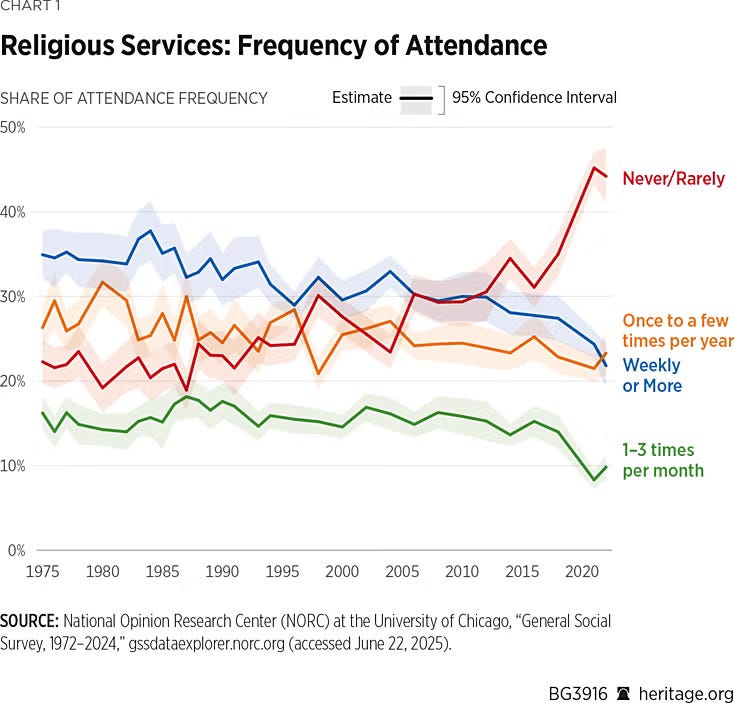
Research presents a fundamental dichotomy: Churches are bigger than ever, drawing bigger crowds than ever; yet people have grown increasingly apathetic to the Church as a necessary institution in human life. Or, as Buechner imagined we might ask after growing tired of the sign in the stars, when it comes to the Church, it seems more and more people are asking, “So what?”
Big Churches aren’t a problem; devaluing the church is. The shift the Church in America so casually drifted into was changing the aim from stewarding the mysteries of the coming kingdom of God, together as a community—where the last is first, and the first is last, where the poor in spirit inherit the kingdom, where to be exalted you must be humble—to an aim at the individual. Away from God and what God wants; toward the individual and what the individual wants.
Clearly, you can reach people with the gospel AND have a high ecclesiology.7 In fact, I would argue you can’t reach anyone properly without a high ecclesiology.
Acts consistently records God adding to his church. Acts 2:47 says, explicitly, “Day by day the Lord added to their number those who were being saved.” The more they valued the Church as Christ's communal bride, the more the Lord allowed it to increase. Jesus said it like this:
No one puts new wine into old wineskins; otherwise, the new wine will burst the skins and will spill out, and the skins will be ruined. But new wine must be put into fresh wineskins.8
Is the answer for the decline in the American Church to dig our heels in and, like Blockbuster, try whatever might work next to draw in the masses until “something” does? Or is it to ask fundamental questions like, “So what?” “Why do we exist?” “Why do we matter?” “What are we really doing here?”
Those questions are more demanding because answering them requires foundational work; it requires us recognizing we’ve lost the point.
Americans have a generally low view of the Church—it is negligible in our lives. We can miss it and not care. We can ignore it for months and never notice. In America, it is possible to “follow Jesus” and never participate in his Church—his body.
Yet moments like this are when the historical Church takes on a new/old meaning, and its value is restored in remnant fashion.
Recovering a High View of Church
To recover a high view of the Church, we will first have to recover a communal view of the gospel. I explored the gospel in a separate writing, which you can find here. Will Willimon writes about the Church by explaining, “We live as those who know something about the fate of the world that the world does not yet know. And that makes us different.”9
Jesus died for us. The invitation relating to Christ’s victory is for us to respond. Eschatology—what happens at the end of things—is about us being redeemed, once and for all. We are the body of Christ.10 This good news doesn’t work properly within the American Enlightenment philosophy of self; it works only within an ancient collectivist philosophy. The ancient church preached about serving others so that all of us, together, might move forward into the joy of his kingdom. They saw participation in the body of Christ as necessary for formation, evolving as disciples of Jesus, and bringing God’s kingdom on earth as it is in heaven. They understood salvation as God radically stepping into humanity's rhythm of sin and darkness and ending it, once and for all.11
Ellen F. Davis, Old Testament scholar at Duke University, wrote in 1999,
The Christian church in America needs to rethink its situation because we are now becoming a minority. We must learn to understand and speak well for what we believe. It is a call we cannot afford to ignore; nostalgia is not likely to carry the Western church beyond another generation or two…Ordinary Christians must now practice talking about our faith, studying seriously, teaching our children just what it means to be a Christian.12
What started as deconstruction needs to be furthered into formation, as curiosity is the path to discovery. The church exists for the community over the individual; that’s the most basic embodiment of Christ's ways to the world. Seeker-sensitive won’t work for community-shaped formation. There won’t be a superstar pastor or personal preference found here; Paul writes, “God has arranged the body, giving the greater honor to the inferior member[s].”13 Services are meant to be gatherings around the table of the Lord, where all are welcome to participate, where all are at home, where all matter, where every story is important, where every struggle and triumph is shared, that help the community become what God desires: a bride.
Although megachurches increased over the last 50 years, another type of church has emerged over the last 10 years: liturgical and traditional churches.
According to a recent study done by the Orthodox Studies Institute, 65.3% of converts to Orthodox churches since 2013 have come from a Protestant background. 60 percent of all converts to Orthodox churches cite theological reasons for converting. Furthermore, former Protestants have an 81.7 percent engagement score in Orthodox churches, the second-highest of any background group.14
The Rev. Dr. Ronald Moore recently wrote in an article on why liturgical churches are growing,
For several decades, the dominant model of worship in American evangelicalism has resembled a rock concert more than a reverent assembly before the Holy. The lights, screens, stage design, and casual attire created a sense of accessibility—but at the cost of transcendence. Increasingly, believers are longing not for a show, but for sacred space. The deep hunger for reverence, awe, and holiness is drawing them to liturgies that center not on personality but on Christ.15
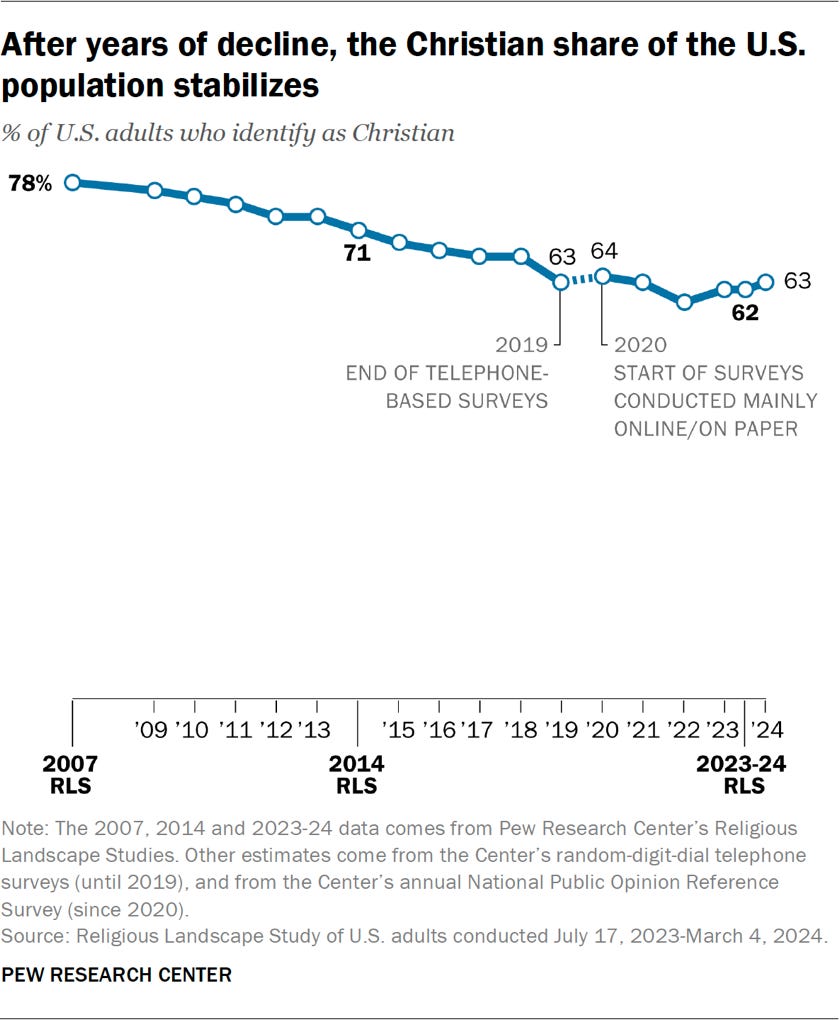
As Americans have turned toward liturgical expressions that center on community and embodying the holiness and wonder of Christ, the decline in religious participation has plateaued and begun to grow again. As you can see from the graph below, from 2022 to 2025, the number of American adults who claim to be Christian has actually grown.16
My point is really Buechner’s point from the beginning. What humans long for isn’t just proof; it’s presence. We don’t just want to know God; we want to experience him. The American way taught us to know God through methods, knowledge, metrics, hype, momentum, and relevance, emphasizing personal growth even if that means ignoring those around us. However, the kingdom of God teaches us to experience God through embodying the gospel within the community of God’s people.
A new day is here. A day when “the glory of the Lord shall be revealed, and all people shall see it together.”17
Jügern Moltmann reflected,
Paul, Christ’s witness, proclaims, “The night is far gone, the day is at hand. Let us then cast off the works of darkness and put on the armor of light.” So it is time to get up from sleep, to forget the dreams and the night terrors, and to experience life in the light of God’s new day, which is now dawning…
“Get up,” says Christ to the benumbed disciples, “let us be going.” So let us also go with eager attentiveness to each new day. We are expected.18
Frederick Buechner, Secrets in the Dark: A Life In Sermons (HarperOne, 2006), pp. 18-19.
Acts 2:44.
See: William Bristow, “Enlightenment,” in The Stanford Encyclopedia of Philosophy, ed. Edward N. Zalta and Uri Nodelman, Fall 2023. (Metaphysics Research Lab, Stanford University, 2023), https://plato.stanford.edu/archives/fall2023/entries/enlightenment/.
Jake Meador, “The Misunderstood Reason Millions of Americans Stopped Going to Church,” The Atlantic, 29 July 2023, https://www.theatlantic.com/ideas/archive/2023/07/christian-church-communitiy-participation-drop/674843/.
“Megachurch Research - Hartford Institute,” 29 October 2024, https://hirr.hartfordinternational.edu/research/megachurch-research/.
Jonathan Abbamonte, “The Great Falling Away: The Decline in Religious Services Attendance in the United States Over the Past 50 Years,” The Heritage Foundation, n.d., https://www.heritage.org/conservatism/report/the-great-falling-away-the-decline-religious-services-attendance-the-united.
Ecclesiology is the study of the Church.
Luke 5:37-39.
Fleming Rutledge, Advent: The Once and Future Coming of Jesus Christ (Wm. B. Eerdmans Publishing Co, 2018), p. xi.
See 1 Corinthians 12:12-27.
Romans 5:18.
Ellen F. Davis, Virginia Theological Seminary Bulletin, July 1999.
1 Corinthians 12:24.
Matthew Namee et al., “Converts to Orthodoxy: Statistics and Trends from the Past Decade.”
The Rev Dr Ronald Moore, “Why the Liturgical Church Is Growing Again,” Substack newsletter, The Southern Anglican, 2 June 2025.
Gregory A. Smith et al., “Decline of Christianity in the U.S. Has Slowed, May Have Leveled Off,” Pew Research Center, 26 February 2025, https://www.pewresearch.org/religion/2025/02/26/decline-of-christianity-in-the-us-has-slowed-may-have-leveled-off/.
Isaiah 40:5.
Rutledge, Advent, p. xii.